Case studies

MM Sports

MM Sports is one of the largest players in the Nordics when it comes to food supplements, training clothes and gym equipment. The company was founded with a passion for strength training and a goal to offer the market's highest quality nutritional supplements. Since its inception in 2002, MM Sports has undergone significant development and has transformed from a small company to a dominant player in the nutritional supplement industry.

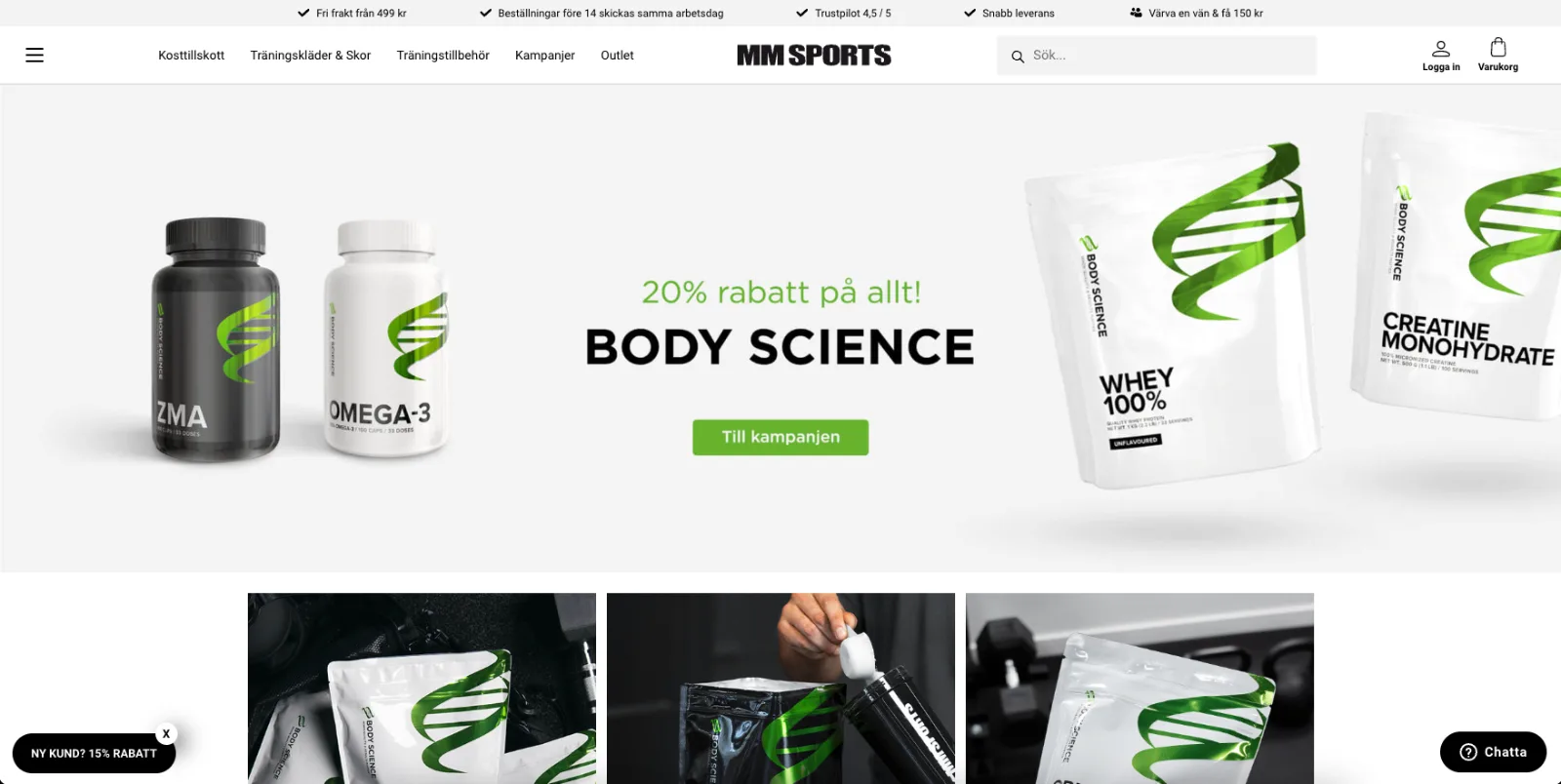
MM Sports e-commerce with promotion for Body Science
Analysis of deficiencies
Complete action plan
AI-based tools

A growing e-commerce player

With a base in Gothenburg and customers throughout the Nordic region, MM Sports is one of Sweden's leading e-tailers in dietary supplements and exercise equipment. In recent years, the company has grown strongly, both in turnover and in digital presence, and is now facing new demands – not only from the market, but also from the legislators in the form of the new EAA directive.

MM Sports website viewed on a laptop

EAA – from obligation to opportunity

When the European accessibility directive (EAA) comes into effect at the end of June 2025, it will affect all e-retailers with a turnover of more than SEK 20 million. For MM Sports, who are constantly working to improve the user experience, it quickly became clear that this was not just a matter of legal compliance, but of doing the right thing for all their customers.

But even for a digitally mature company like MM Sports, the new directive meant a narrow landscape of technical requirements, regulations and guidelines. Internally, there was neither time nor sufficient competence to assess for themselves what actually needed to be done.

We knew the law was coming, but it was hard to fathom the magnitude. We didn't want to take any chances, but quickly realized that we needed someone who could translate legal text into concrete action

Simon Nylander, Head of E-Commerce, MM Sports

A structured process

HERE began the collaboration by carrying out a comprehensive scan of the entire mmsports.se. Over 2000 pages were analyzed based on accessibility standards according to WCAG and EAA. In the analysis, patterns were identified, which made it possible to focus on a selection of representative pages: homepage, category pages, product pages and some more unique parts of the site.

But a report of hundreds of pages of technical flaws is not useful if it cannot be put into practice. Therefore, an educational action plan was developed – page by page, point by point – and delivered in a format that could be used directly by the company's developers. A clear checklist in Excel complemented the produced presentation, giving the team at MM Sports full control over what needed to be done.

The most important thing for us was that it was easy to understand and act on. We could take the material and get started right away, without having to interpret or reformulate anything

Jennifer Larsson, E-Commerce Assistant, MM Sports

Tools to facilitate

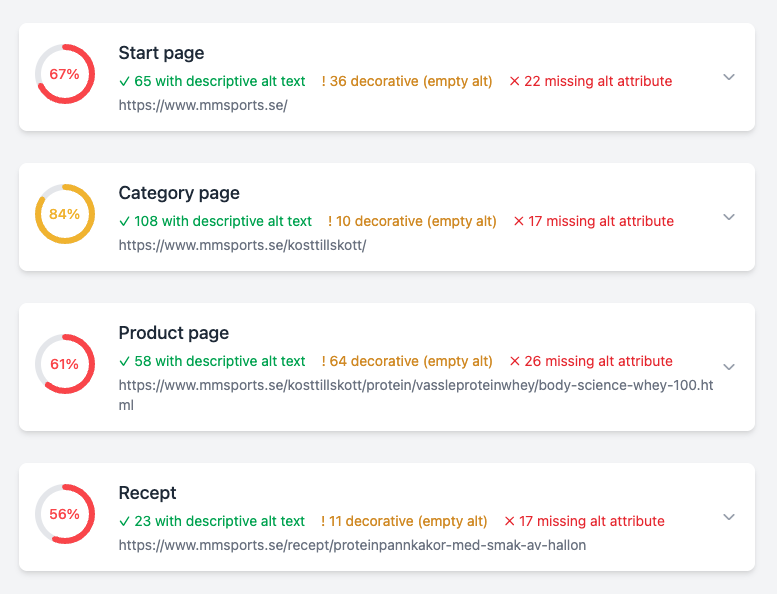
To future-proof the work, HERE also developed several of its own AI-driven tools with the aim of facilitating the ongoing work on the website. Among other things, a tool for measuring text contrast based on WCAG (Web Content Accessibility Guidelines) and another tool that automatically identifies images that lack alt tags. Two frequently recurring accessibility problems.
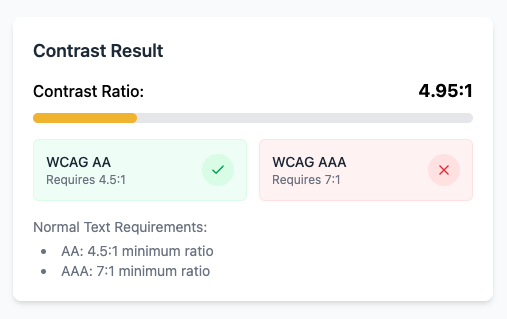
Tool for text contrast according to EAA
Text contrast
Tool to find images that lack alt tags according to EAA
Alt tags

It is only when you look at a site through the eyes of someone with a disability that you realize how difficult it can actually be to navigate, take in information or complete a purchase. It is not just about a legal requirement, but about respect, inclusion and wanting to do the right thing

Niklas Johansson, Digital Growth Specialist, HERE

An instructive insight and important reminder

For the team at HERE, the project became not only a mission but also an eye-opener.

The project resulted in a concrete action plan, fully adapted to MM Sports' actual needs. With its support, they can meet EAA's requirements in a structured way and at the same time offer a more accessible and inclusive experience for their customers.

But above all, the collaboration brought peace to the organization. A receipt that you not only do what the law requires, but that you go ahead and take responsibility.

HERE helped us make something complex simple. We really appreciated how concrete, educational and useful the material was. This allowed us to go from analysis to action in a very short time

Jennifer Larsson, E-Commerce Assistant, MM Sports

Working with accessibility is not a project – it's a process. Together with MM Sports, we have not only identified areas for improvement, but also laid the foundation for ongoing, long-term work. With the help of our own tools and a strong internal driving force on the part of the customer, we are convinced that MM Sports will become an example in digital accessibility in the e-commerce industry

Niklas Johansson, Digital Growth Specialist, HERE
FAQ

Frequently asked questions related to the case

What is digital accessibility?

Digital accessibility means that everyone, regardless of functional ability, should be able to use websites, apps and other digital services. This applies, among other things, to people with impaired vision, hearing, motor skills or cognitive ability. Today, over a million Swedes live with some form of disability.

What is WCAG?

WCAG stands for Web Content Accessibility Guidelines. It is an international standard with guidelines for how digital content should be designed to be accessible.

  • Sufficient color contrast between text and background
  • That all content can be accessed and used with a keyboard
  • That images have descriptive alternative text (alt texts)
  • That the user receives clear feedback in the event of an error in the form
What is the EAA - the European Accessibility Directive?

The EAA (European Accessibility Act) is an EU directive that aims to create a more inclusive society by setting accessibility requirements for digital products and services. This applies, for example, to websites, apps, ticket systems, e-books and payment solutions.

Who is covered by the EAA?

The EAA applies to private and public actors within the EU that offer certain types of products or services. It includes, among other things:

  • Banks and e-payment solutions
  • Transport company with digital ticket systems
  • Manufacturer of computers and smartphones
  • Web shops and other companies with e-services
  • Publisher of e-books
  • Emergency service providers
When does the EAA come into effect?

The directive comes into force in Sweden on June 28, 2025. It applies to products and services released after this date. Older solutions that continue to be developed also need to meet the requirements.

What are some examples of what must be available?

Examples of what must work for people with disabilities:

  • A blind user must be able to access a website with a screen reader.
  • A person in a wheelchair should be able to navigate an app without using a mouse.
  • A user with color blindness must be able to interpret graphs and buttons and be able to easily read texts.
  • A person with impaired hearing must receive information even without sound.
What happens if you don't follow the law?

Companies and organizations that do not meet the requirements risk supervision, injunctions and in some cases fines. But most importantly – you risk excluding users and customers.

How do we know if our service is accessible?

This is done through an accessibility analysis according to WCAG. It is an examination of, for example, your website, app or e-service to identify obstacles and provide suggestions for measures.

Is accessibility just a legal issue?

No. It's just as much about being inclusive, professional and customer-focused. An accessible service is easier to use for everyone – not just people with disabilities.

Do we have to customize the entire site?

Yes, in principle. But this does not mean that each page must be reviewed individually. Often the site shares a structure – for example, all product pages look the same. By analyzing representative page types (such as start page, category page, product page and cash flow), it is possible to streamline work and still meet legal requirements.

What is included in an accessibility analysis?

An accessibility analysis means that we review the website based on WCAG guidelines. We identify shortcomings, visualize problem areas and present a concrete list of what needs to be fixed. The analysis can then be used directly by developers and designers.

Is this something we can do ourselves?

It is possible, but it requires good technical understanding and knowledge of both WCAG and the law behind the EAA. Many therefore choose to bring in external help to save time, reduce risk and achieve a solution that really works for the users.

Can you help us even after the analysis?

Yes. We not only offer analysis, but also ongoing advice, training and tailored tools so that you can continue working with accessibility on your own. For example contrast control tools, alt-text controls and developer checklists.

Case Studies

Contact us

Do you want to create a similar result as MM Sports?

Tell us about your goals and challenges and we will show you how strategy, implementation and follow-up can be connected in a concrete plan.

Contact person

Robin Pettersson+46 (0)723 - 32 75 10